Cement manufacturing does have an impact on the surrounding environment so Lafarge is committed to reconciling industrial imperatives with the preservation of ecosystems.
Becoming more sustainable is a commitment of Lafarge in all of its operations.
Becoming more sustainable is a commitment of Lafarge in all of its operations. |
|
|
Cement manufacturing consumes large quantities of non-renewable raw materials (minerals and fossil fuels). It is also an important source of CO2 emissions.
In response to this environmental challenge, Lafarge has been committed to the path of industrial ecology since the mid-70s. This approach is inspired by the cycles of creation, destruction and recycling that occur in nature.
By rethinking industrial processes from start to finish, one industry's waste products can become another industry's resources.
Why find uses for waste?
The Group is aware of the impact of its activities on the environment. As a result, Lafarge started thinking at a very early stage about ways of reconciling industrial imperatives with the preservation of ecosystems.
Adding value to waste by using it as alternative fuel or materials, makes it possible to:
Based on 1990 levels, Lafarge Cement UK has achieved over 30 per cent reduction in gross CO2 emissions by 2007. The benefit for the planet was equivalent of taking 600,000 cars off the road and was achieved through a combination of using carbon-neutral materials and investing in our operations to allow older manufacturing units to be closed. Industrial ecology practices are, therefore, beneficial for the community and the environment and also have economical benefits for Lafarge.
Waste-derived fuels
Waste products can be a very appealing alternative to fossil fuels. In general, alternative fuels are derived from waste or byproducts from agriculture (biomass) and industry:
All of these products can be recycled as waste-derived fuels and burned safely in cement kilns. This approach relieves the community of the need to process this waste and helps to limit CO2 emissions. The extremely high temperatures found in cement kilns mean that the waste is totally eliminated and does not leave any residue. At present, alternative fuels account for 10.7% of the Group's fuel use across all businesses and around 20% in our operations in the UK.
Waste-derived materials
The cement manufacturing process generates CO2 because the limestone needs to be heated to very high temperatures. This physical-chemical process of "decarbonation" produces clinker, which is then ground down. It is possible to reduce the amount of clinker in cement by using alternatives, called cement additions. Reducing the amount of clinker in cement offers two advantages:
A cement produced with 30% additions uses 230 kg or 27% less CO2 than a conventional cement produced without additions. Cement additions may be of: natural origin:
industrial origin:
These waste products have the same hydraulic binding properties as clinker. For example, in the UK, Lafarge blends pulverised fuel ash into a lot of its packed products.
Lafarge expertise results in safe waste solutions
The use of waste products cannot be improvised. Lafarge has implemented stringent quality control standards as well as a training policy for its engineers, technicians and foremen. In this way, it is reinforcing the use of alternative fuels and materials while controlling industrial processes. The Group's R&D teams are also making an active contribution in this respect.
Lafarge Cement UK considers the use of alternatives and the pursuit of industrial ecology to be separate but complementary parts of its core business. The company has developed a highly professional resource recovery business to source potential materials that can meet the stringent quality parameters required for use in cement-making.
|
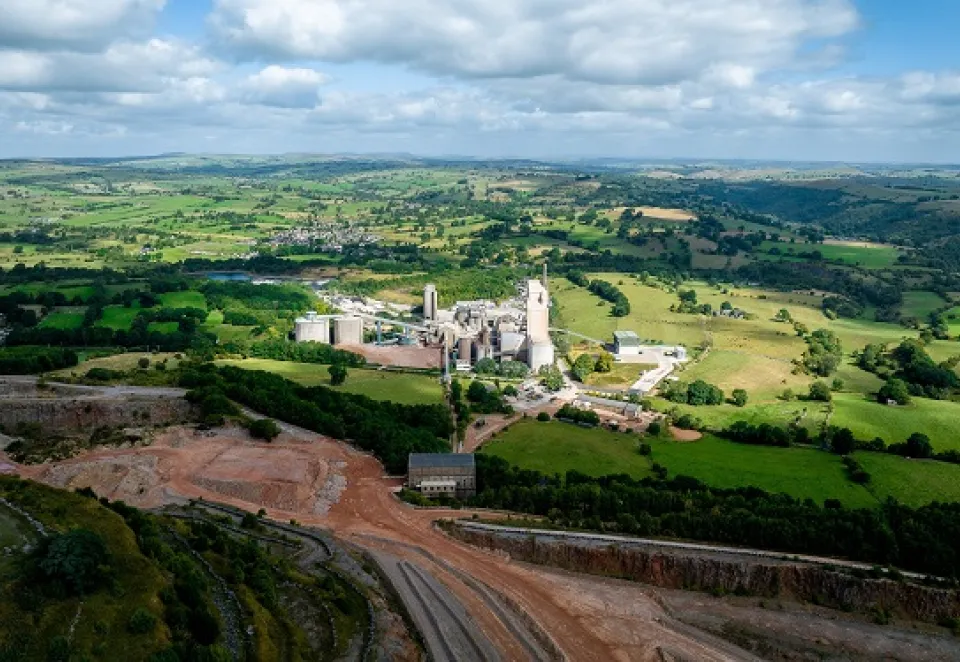
Cauldon Works quarry (Credits: Samuel CO2 and cementWhy does the manufacture of cement produce CO2?
Cement manufacturing is the source of 5% of global CO2 emissions. The cement industry is a natural producer of CO2:
Clinker
Clinker is the main ingredient in cement. These hardened granules are obtained by firing a mixture of approximately 80% limestone and 20% clay to a high temperature. Cement is obtained by grinding clinker and, in some cases, supplementing it with additives.
Cauldon Works shale lake(Credits:Sam Pulverised Fuel AshPulversied Fuel Ash (PFA) is hydrophilic and can be used as a cementitious additive. The ash, which is collected from chimney filters in coal-fired power plants, is composed of vitreous silica, alumina, iron oxide and lime. They can be used as a partial substitute for clinker and thus help to reduce CO2 emissions Meat and bone meal |